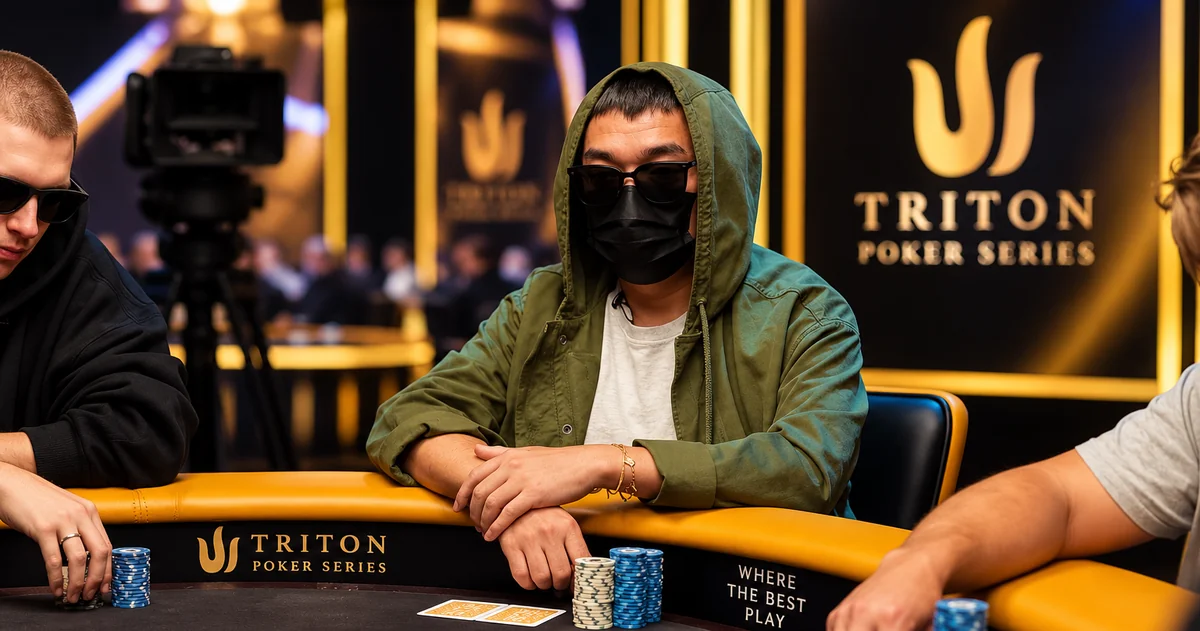
Semi Sun sat on one of the three biggest stacks when hand-for-hand play began in the $200,000 Triton Invitational at Triton Super High Roller Series Jeju II. A few hands later he was the bubble boy — out without a cent, one spot short of a $305,000 min-cash, after a river bluff ran straight into a full house.
- Semi Sun of the Philippines busted the $200,000 Triton Invitational on the bubble despite holding a top-three stack.
- The field of 172 entries built a $34,600,000 prize pool; the 31 survivors locked up at least $305,000.
- Yang Wang had been at risk minutes earlier, but doubled up with pocket aces and became the table chip leader.
- Sun’s all-in river shove with 8♣5♣ was snapped off by Wang’s A♦7♥ — sevens full.
- The event wraps up on Monday, September 14, with $7,250,000 for the winner.
A Bubble Full of Double-Ups
The Triton Invitational is the marquee event of the Jeju II series, and its bubble was anything but quiet. Sun was the chip leader at his table when the tournament went hand-for-hand, and from there the short stacks refused to go away: roughly half a dozen players doubled up before anyone was finally sent home empty-handed.
One of those survivors was Yang Wang. With his tournament on the line, Wang found pocket aces and doubled up to take over as chip leader of the table. Jesse Lonis paid the price: Wang doubled through the pocket jacks of Lonis, leaving the American pro short-stacked and sweating the bubble himself. Wang’s revival turned out to be the worst possible news for the player sitting on the button.
Why the Bubble Is So Brutal
The bubble is the point in a tournament where the next player eliminated leaves with nothing, while everyone else is guaranteed a payout. Organisers usually switch to hand-for-hand play at this stage, with every table playing one hand at a time so that no one can stall to sneak into the money. In a $200,000 event, the pressure is immense: the difference between busting one place short and reaching the money was $305,000.
That pressure changes how players behave. Short stacks fight to survive, while big stacks can use their chips to put pressure on opponents who cannot afford to call. Sun, sitting on one of the biggest stacks, was in exactly the position where aggression is usually rewarded — which makes his exit all the more painful.
The Hand That Burst It
Blinds were 30,000/60,000 with a 60,000 big blind ante in Level 20 when Wang opened to 140,000 from middle position and Sun called on the button.
- Preflop: Wang raises to 140,000 from middle position, Sun calls on the button.
- Flop 7♣ 7♠ 8♠: Wang bets 225,000, Sun calls.
- Turn A♥: Wang bets 450,000, Sun raises to 1,100,000, Wang calls.
- River Q♠: Wang checks, Sun moves all in for 2,100,000, Wang calls instantly.
- Showdown: Wang A♦7♥ (full house, sevens full of aces) beats Sun 8♣5♣ (two pair, eights and sevens).
On paper Sun’s line told a strong story. He flatted the flop on a paired, two-spade board, then put in a big raise when the ace hit the turn — exactly how a player holding trip sevens or a slow-played big hand might play it. When the Q♠ completed the flush draw and Wang checked, Sun fired his last 2,100,000 into the middle to represent the nuts.
The problem was that Wang had turned a full house. Holding ace-seven, he had flopped trips, filled up on the turn and was never folding. He called immediately, and Sun’s eights-up bluff was exposed.

Was the Bluff Reasonable?
Sun's plan made sense in theory. On a board of 7-7-8 with two spades, raising the turn after an ace appeared allowed him to represent a seven, a full house or a strong draw that had improved. When the queen of spades completed a possible flush on the river and Wang checked, a big bet could credibly tell the story of a flush or a full house, and many players would struggle to call off a large stack with a hand like a weak ace.
The problem was the range Wang actually held. By opening and then betting the flop and turn on a board containing two sevens, Wang's line was consistent with a strong hand, and his ace-seven was one of the best possible. With a full house, there was no decision to make. Sun found himself bluffing into one of the few hands that could never fold.
From Seven Figures to Zero
The bubble had burst. Sun’s seven-figure stack was gone in one hand, and with it any claim to the $305,000 that each of the remaining 31 players had just guaranteed themselves. For a player who had been cruising on one of the biggest stacks in the room, it was about as brutal an exit as high-stakes poker can deliver.
Wang, meanwhile, went from nearly out to a big stack in the money within a matter of minutes — the kind of swing only a bubble in a $200,000 event can produce.
The Triton Invitational is the series' signature event, with the highest regular buy-in on the circuit. Its fields combine elite professionals with wealthy businesspeople, and its prize pools are among the largest in poker. Earlier in the year, Spain's Adrian Mateos won the Invitational at Triton Montenegro for more than $6.3 million, underlining what is at stake every time the event runs. For the 31 players who made the money in Jeju, a first prize of $7,250,000 is now within reach — and for Sun, the memory of one river decision will take a long time to fade, however many more Triton events he plays, and however many deep runs he makes in the future. Bubbles in events of this size are rarely forgotten, either by the player who bursts them or by the rest of the field watching from the next table.
What’s Next
The three-day Triton Invitational concludes on Monday, September 14, when the last of the 31 players in the money will play down to a champion. The winner will collect $7,250,000 from the $34,600,000 prize pool.
Related reading
- Did Phil Ivey Punt With Pocket Aces? The Solver Says No
- Was Nicholas Palma's Ace-King Shove at the Poker Masters a Mistake? The Solver Weighs In
- Former Congressional Candidate Loses $1 Million Poker Pot After Dramatic Comeback