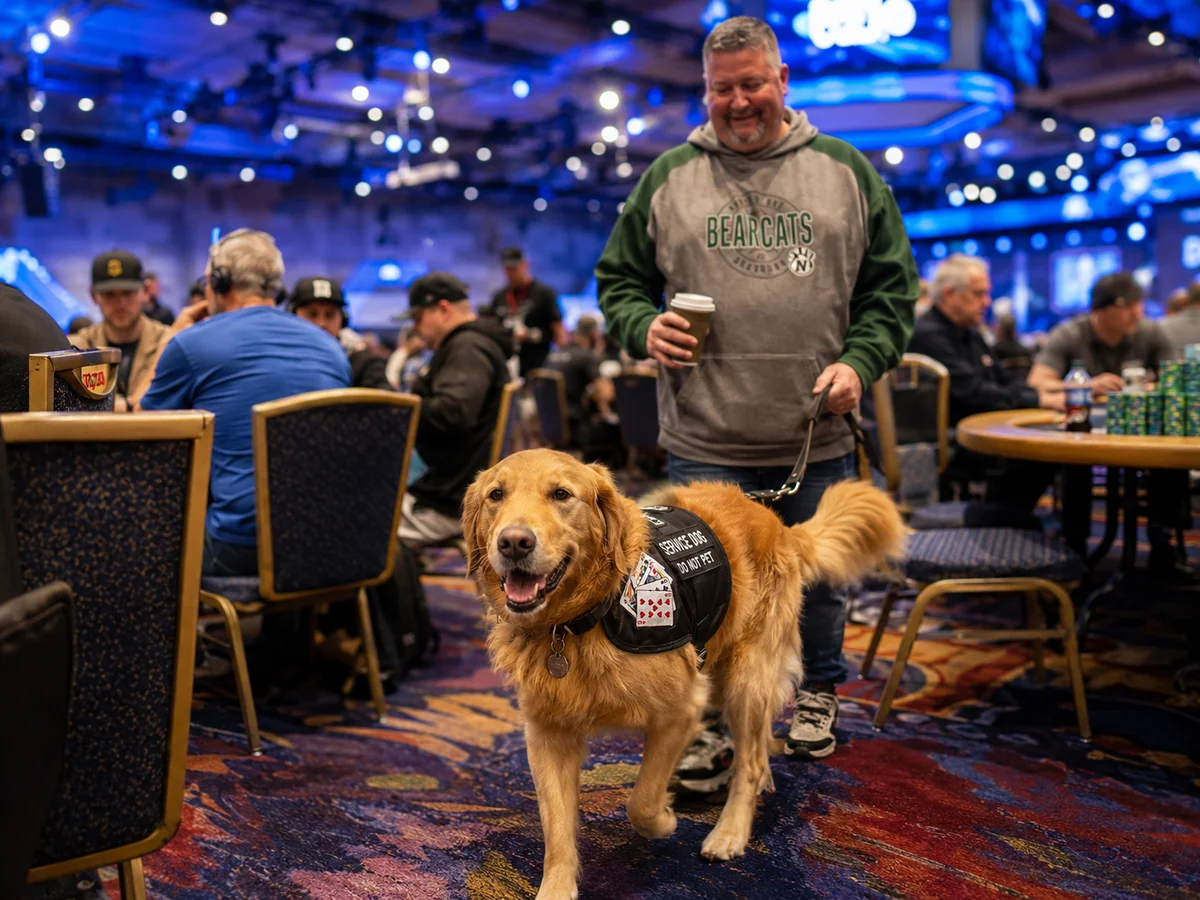
Among the thousands grinding it out at the 2026 World Series of Poker, few drew more affection than Ben Ditsch — and his Golden Retriever, Chief, the service dog who quite literally keeps him alive at the table.
Key takeaways
- Ben Ditsch, a low-stakes pro from Grain Valley, Missouri, lives with Addison's disease — a condition affecting roughly 10,000 Americans.
- His three-year-old Golden Retriever, Chief, senses dangerous cortisol crashes and alerts him before they turn life-threatening.
- Only about 75 service dogs nationwide can perform that alert.
- Ditsch reached Day 2 of the WSOP $1,500 Monster Stack — the biggest buy-in he has ever played.
If you spent any time at the 2026 World Series of Poker, chances are you crossed paths with Ben Ditsch of Grain Valley, Missouri — and you almost certainly noticed Chief, the calm three-year-old Golden Retriever at his side. Dogs at the felt can be a divisive subject, but for Ditsch his four-legged partner is not a luxury; he is a medical necessity.
A rare disease, an even rarer helper
Ditsch has Addison's disease, a disorder in which the body fails to produce enough cortisol — the hormone that keeps a person alive. As he puts it, "it's like being diabetic but worse," and only around 10,000 people in the United States have it. Left unmanaged, an episode can become fatal within half an hour.
That is where Chief comes in. The dog is trained to read the warning signs long before Ditsch feels them himself.
"When the cortisol drops too low, he'll jump up and lick my face — that tells me it's time to take meds. If the emergency shot doesn't work, I have to call an ambulance, because I'll be dead within 30 minutes. So yeah, you can say he's saved my life several times."
— Ben Ditsch
Remarkably, Chief's ability to detect those drops is rarer than the disease itself: Ditsch says only about 75 service dogs across the country can do what Chief does.
How Chief found his calling
Chief was not originally brought in for cortisol alerts. Ditsch got him at just eight weeks old to help with mobility after surgery on his spinal cord — a 3.5-inch mass left him with severe weakness down his left side from the waist down. The life-saving talent was discovered almost by accident during a casino session.
"They said, 'You know he licks your face 10 minutes before you call for an ambulance?'" Ditsch recalls. He went home, began testing the dog, and by 11 months old Chief was alerting accurately — even doing it in front of his doctors. He has been a service dog ever since.
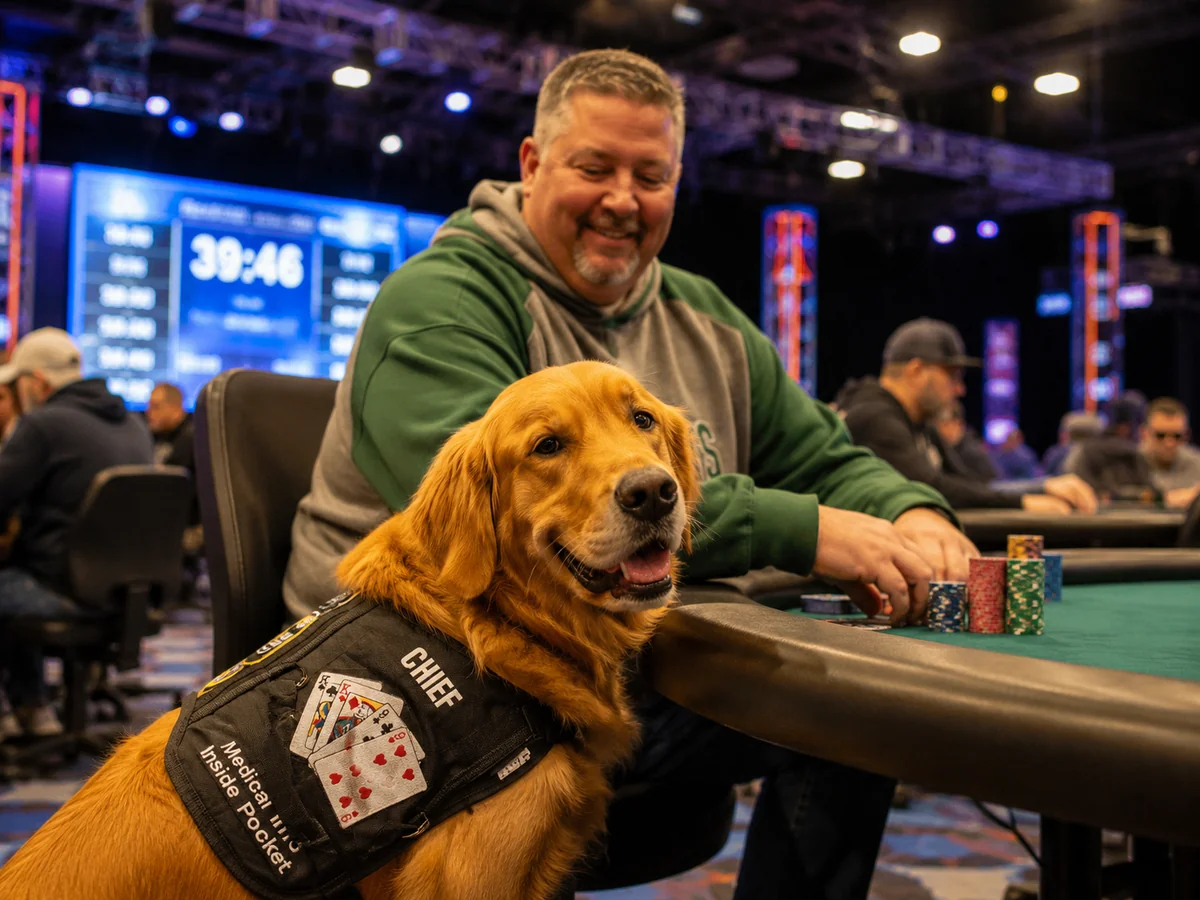
Ditsch and Chief take on the WSOP
Now 44 and medically retired, Ditsch has packed a lot into his working life — poker dealer, TV cameraman, paramedic, and sound and lighting tech. These days he calls himself a low-stakes professional, mostly playing $1/3 cash games. Multi-day tournaments are usually off the table because a flare-up can mean paramedics or hospitalization, something that happens three or four times a year.
Even so, he won his way into the WSOP $1,500 Monster Stack through his home game league and made it to Day 2 — by far the biggest buy-in he had ever played. He didn't reach the money, but he shared tables with the likes of Ben Grise and Steven Buckner, met one of his idols in Phil Hellmuth, and got a friendly hello from Erick Lindgren, who stopped to pat Chief. The pair's favourite moment came celebrating a friend's bracelet, when Brent Gregory won the $600 NLH/PLO Mixed event.
Turning a disadvantage into an edge
Ditsch is starting to find tournament success too, with his first couple of recorded cashes this year. His favourite story, though, is the satellite he won while his cortisol was crashing dangerously.
"I got sick in it, Chief alerted, I took my meds — then I realized it was going to get bad, so I just started pushing all in. The ambulance was on its way. I'm trying to lose, and I just kept winning. The ambulance showed up right before break, my meds kicked in, and I went back and won the damn thing."
— Ben Ditsch
He jokes that he should bottle that feeling: "I play better when I'm sick, or when I'm feeling off — even though it's technically not the smartest idea."
The debate over dogs at the table
Ditsch is the first to acknowledge that a dog at the table can be awkward for others, whether through allergies or simple logistics, and he goes out of his way to accommodate them. The trickiest situations, he says, come down to where Chief can safely sit — not under a neighbour's feet, but not blocking a walkway where a passer-by could trip over him either.
"What's safer," he asks, "blocking the walkway, or somebody falling, breaking their arm, and hurting the service dog that has every right to be there?" Happily, he says such friction is rare. At both the WSOP and his home room, Harrah's Kansas City, Chief is treated like a star — complete with hot dogs and a daily stash of treats waiting for him.
Poker as a return to normal
More than the cards, what poker gives Ditsch is a sense of normalcy — a reason to leave the house, talk to people, and simply enjoy life despite a disease that can take days to recover from after a hospital stay.
"It's poker — it just lets me go out, have fun, and meet people. I just wish I could find a cute girl. Chief always finds the married women."
— Ben Ditsch